In the early 1990s, I began my woodworking journey with a couple of vintage Stanley bench planes and a Fine Woodworking book on hand tools. I dutifully followed the book’s instructions on setting up and sharpening my new planes, and everything was going pretty well until I came to the section on setting the cap iron (also known as the chipbreaker). According to the author, for difficult hardwoods I was supposed to set the edge of the cap iron “as close as possible” to the cutting edge. So I did, and disaster ensued. I could barely push the plane; it shuddered, shook, and quickly came to an unceremonious halt, the mouth hopelessly clogged with balled-up shavings. I moved the cap...
It’s been a wild ride working on the 1810 house project. We’ve been planning the rubble trench and granite block foundation, cleaning up and selling my double wide home (gone first week of June!), setting up the cottage for moving into (building railings for the loft, digging a water line, running wiring, etc). Anyway, there’s been a lot going on around here. But in the midst of it all, Issue Twelve arrived! Our printer, Cummings Printing, has done a top-notch job, as always. We moved to them a few issues ago and have been so impressed with their consistency and quality. And the page spreads in this one are fun to flip through because the photographs are so captivating. I...
It’s maple sugar season here in New England. When the days are above freezing but the nights are still frosty, the maples (Acer spp.) begin sending copious amounts of sweet sap up the trunk and into the limbs, readying the buds to leaf out when the time comes. We tap a few of our trees every year – rarely more than a dozen. A decent-sized maple can put out more than a gallon of sap per day, per tap, and all this precious liquid must be gathered, cooked down, and finished into syrup or (better yet) maple sugar. It might be the best stuff on earth. Larger producers use food-grade vinyl tubing to pipe all the trees in their “sugarbush” together,...
…A winning wave, deserving note, In the tempestuous petticoat; A careless shoe-string, in whose tie I see a wild civility: Do more bewitch me, than when art Is too precise in every part. -“Delight in Disorder,” by English poet Robert Herrick (1591-1674) I recently started making a new table. And, as is often the case when I buckle down and start something that requires attention—whether it’s a tricky piece of furniture or a short story or a diplomatically worded response to panicked student email sent to me in a Mountain Dew-fueled haze at 2:30 the morning before a due date—I thought of an old joke. It goes like this: “How do you make God laugh?” “Make a plan.” (Rimshot.)...
Mike U and Mike C assemble a railing for the cottage. Well… spring is officially here. Not only have we passed March 20th, but we’ve had our seasonal soggy mess (mud season, we call it) and freeze/thaw ground heaving. But also around this time, things begin to come to life. This year is no different. This 1810 house restoration project has been progressing steadily but slowly over the past few months as we’ve been finishing off our small timber-frame cottage for living in during construction and coordinating untold details and people to get everything lined up where we need them to be. Friends and family ask me how the house is coming and I’m embarrassed to not be able to show...
Analyzing our data pools, it became apparent that handmade furniture doesn’t remain within its average tolerances the way machine-made furniture does within its level of precision. This 0.01" mechanized range is an absolute boundary, and for the most part there are simply no outliers beyond it. Straight and parallel are predictably regulated by machines, and are in fact necessary for the industrial manufacturing process. CNC machines, for example, rely on unmovable benchmarks that must be established to function properly. Throw a piece of tapered, warped, rough-cut lumber on the worktable, and you’re asking for trouble. However, the measurements we took from our pre-industrial examples were rife with outliers – areas of noticeable, often radical divergence from general tolerances. It is...
In this episode, Joshua and Mike discuss something they both feel strongly about – the primacy of wooden hand planes. In unpacking Joshua’s article in Issue Twelve (heading to mailboxes as we speak!) about making your own fore plane, they go over why wooden planes are just plain better than their metal-bodied counterparts, and how approachable the craft of planemaking can be.
Most modern woodworkers view toolmaking as a craft dependent on NASA-level precision, but in his article, Joshua dispels that popular misperception. In this podcast episode, he and Mike talk through the pre-industrial process of planemaking, explaining that appropriate tolerances are determined more by the eye than rule.
SHOW NOTES
Issue Twelve
We have now opened the pre-order window for my brand-new book Worked: A Bench Guide to Hand-Tool Efficiency. This prequel to my last book, Joined, focuses on the way hand-tool-only woodworking actually gets done without fuss. We’ve all seen the painstaking planing procedures and the convoluted workholding setups that attempt to simulate machine work with hand tools. They’re unwieldy and cumbersome. And they give hand tools a bad rap. But this is all a misunderstanding. Hand tools are efficient when used the way they were intended – with “sensible” tolerances. Worked was written to show you what that actually looks like. It was written to reclaim the “hand” in “handcraft.” We’ve got two ways you can pre-order this book: You...
It’s been said that woodworking is little more than marking lines in the right places and cutting carefully to those lines. While simplistic, there’s something refreshing about the aphorism. It is true that knowing where and being able to cut wood is the heart of most woodworking operations. At the same time, in the shop, we are nothing without our tools. And our tools are nothing without a way to secure the stock being shaped. Having a firm grasp on workholding methods is an essential component to artisanal development. Beginners struggle to find a way to hold their stock for comfortable work, and this struggle greatly hinders the cutting action of their tools. But anyone who’s been around for any...
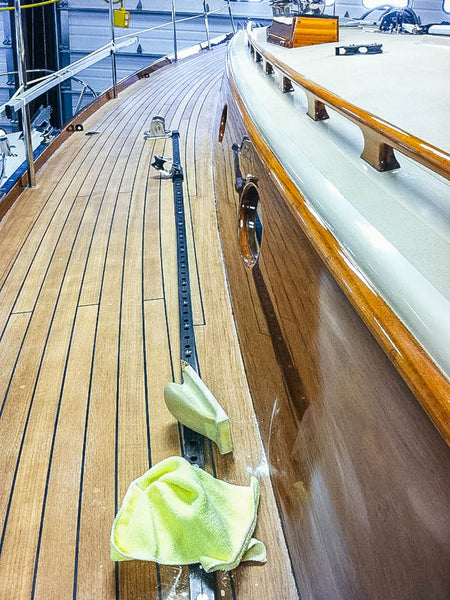
I have a love/hate relationship with sandpaper. Before M&T, I spent better than a decade working on boats – mostly small, wooden sailboats, with the occasional lobster yacht or Nordic tug thrown into the mix. There was a beautiful Herreshoff Rozinante, built as finely as a violin, or that 1937 International One Design racing sailboat from Norway that had sunk three different times – each time, she was raised and repaired. I primarily did paint and varnish work, which meant that I spent winters sanding. A lot of sanding. At the end of each season, all the removable brightwork– tillers, wheels, seats, dropboards, hatches – I pulled off the boat, cataloging and shelving it all in my heated varnish room. The...